
Case Study: MonacoPlate
Project
MonacoPlate: Real-time MONitoring and Automatic COntrol of Industrial ZnNi ElectroPLATing for Supreme Quality, Process Efficiency and Reduction of Harmful Waste Water. To promote the digitalization of industrial electroplating processes, the project aimed to develop innovative techniques for the in-situ control of ZnNi electroplating process steps including degreasing, pickling, electroplating, passivation and wastewater management. The process control was developed separately for each step and was mainly based on electrochemical signals measured with sensors. The electrochemical signals were analyzed using suitable algorithms to control the entire industrial production process. The new techniques were developed in laboratories in Vietnam (ChemEng/HUST) and Germany (IFINKOR, IPS) and tested in industrial automatic ZnNi electroplating plants in Vietnam (PLATO Vietnam) and Germany (Hillebrand, DOK) to improve product quality, process flexibility, safety and sustainability.
Objective
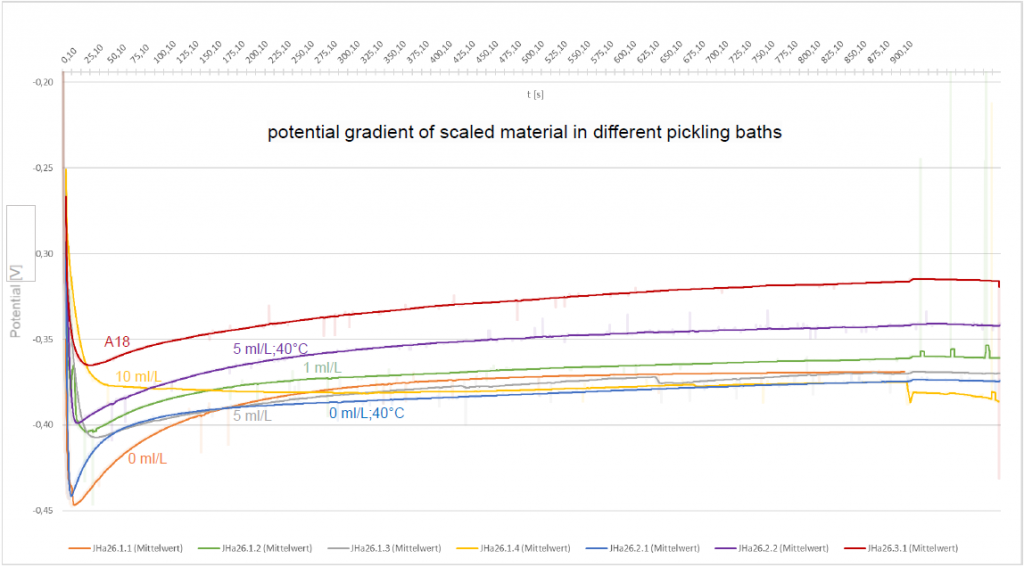
There are already measuring systems for monitoring electroplating baths, but these can only perform measurements ExSitu. The aim of MonacoPlate was therefore to develop and build an InSitu measuring system for monitoring electroplating baths during the deposition process. This objective was achieved by developing a sensor system based on potential transients. The sensor system developed in the project is characterized by the fact that the component to be treated is immersed as an electrode in the respective process bath under its normal operating conditions, and the temporal evolution of the electrochemical potential of the component’s surface relative to a reference electrode is measured from the very beginning. The respective process step is complete when the slope of the potential-versus-time curve approaches zero (dU/dt→0) and a potential plateau is established. The time at which the criterion (dU/dt→0) is reached can be used to control the cycle time of the respective process step, to evaluate the bath effectiveness, and, in the case of the degreasing and pickling process steps, to evaluate the contamination intensity (grease, rust) of the component surfaces to be treated.
Realisation
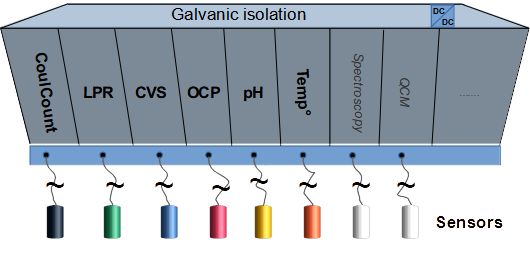
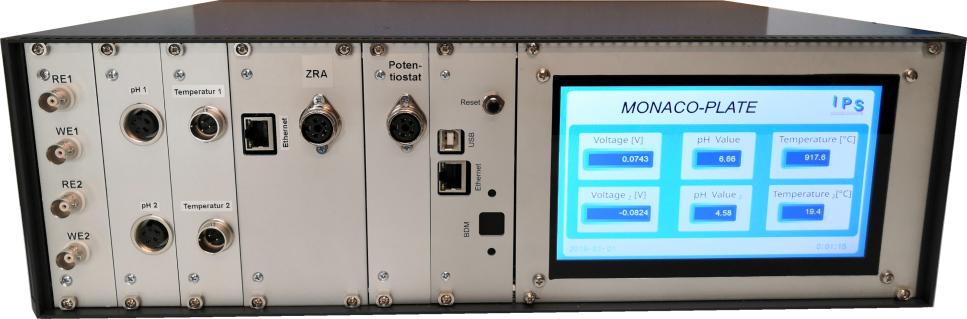
However, under operational conditions, reliable measurement data can only be obtained using fault-tolerant electrochemical measurement technology. To this end, IPS Elektroniklabor GmbH & Co KG developed a multiparameter measurement unit featuring modules for determining potential, pH, temperature, electrochemical noise, and potentiostatic current density/potential curves, as well as a display module. In an innovative approach, complete internal galvanic isolation of all modules was achieved, thereby significantly increasing resistance to interference from operational electromagnetic noise.
In addition, the inputs are routed through high-impedance (differential) amplifiers (1013 ohms) whenever possible.
The first modules were constructed accordingly, and after a few adjustments, they now function together in a (galvanic) bath.
Summary
We call the fully developed device a multi-parameter measuring device.
The methods developed and measured during MonacoPlate provide reliable information about the cleaning, passivation and coating behavior. Based on these measured variables, the process can be evaluated in a well-founded manner and the actual process time can be significantly reduced. Furthermore, a significantly lower consumption of starting materials can be realized.
German and Vietnamese industrial partners have demonstrated that the potential transient method can be applied in industrial production lines. This marks the first time a sensor-based method is available that enables real-time monitoring of treatment steps in electroplating production lines. This achievement has laid the groundwork for digitalization in the electroplating industry.
The project MonacoPlate is part of the R&D project MONACO-PLATE, which was funded by ZIM (Central Innovation Program for SMEs) of the BMWK (Federal Ministry of Economics and Climate Protection) under project no. KK5275101KO1 and coordinated by AiF (Research Network for SMEs)